By Maya Chen, lettering designer and type educator · Checked by Jordan Hale · · How we review content
Key facts
- An Old English text generator produces Unicode Fraktur: Bold Gothic (U+1D56C–U+1D59F) and regular Gothic (U+1D504–U+1D537), both in the Mathematical Alphanumeric Symbols block.
- Unicode encodes only the Fraktur form of blackletter; textura, rotunda and Schwabacher are not available as text.
- Regular Gothic borrows five capitals (ℭ ℌ ℑ ℜ ℨ) from Letterlike Symbols, so they can look uneven; Bold Gothic has no gaps.
- Unicode has no blackletter digits, so numbers stay plain next to Gothic letters.
- Gothic letters work in display names, bios and captions but are rejected in @usernames on Instagram, TikTok and Discord.
- On X, each Gothic letter counts as two characters, and screen readers may spell the letters out one by one.
This Old English text generator turns plain typing into blackletter Unicode letters such as 𝕸𝖎𝖆 𝕮𝖗𝖚𝖟, in bold Gothic and regular Fraktur styles. Copy the result into a name, bio, caption or message. It needs no font install, and your text stays in your browser.
How to use the Old English text generator
- Type your text in the box at the top. Every style updates as you type.
- Pick a style. Bold Gothic is the usual “Old English” look and holds up best on a phone; regular Gothic is lighter.
- Tap Copy on the row you like, then paste it where you want it.
Worked example: a blackletter display name
Typing Mia Cruz gives 𝕸𝖎𝖆 𝕮𝖗𝖚𝖟 in Bold Gothic. Paste it into a Discord display name or an Instagram Name field, not the @username, which rejects it. Use mixed case, not all capitals, because blackletter capitals are hard to read in a row.
“Old English” is a language, not a typeface
The name is a historical mix-up worth knowing before you put it on anything permanent.
Old English is the early form of English spoken from roughly the 5th century to the 12th, the language of Beowulf. Scribes wrote it in rounded insular script, not in the spiky letters people now call “Old English”. Blackletter, the dense, angular style this generator imitates, developed across Europe from about the 12th century, around the time Old English was turning into Middle English. So the two barely overlapped.
The label came later. Blackletter remained a standard English printing type for centuries, and by the 1800s English type founders were selling blackletter faces under names like “Old English” and “English”. The name stuck, and today “Old English font”, “Gothic letters”, “blackletter” and “Fraktur” all point to the same family of lettering. “Gothic” is also a nickname: Renaissance writers used it to dismiss medieval script as barbaric, after the Goths. Our guide what is lettering explains how lettering styles like this differ from fonts and calligraphy. For the actual Old English alphabet (þ, ð, ƿ), see Old English alphabet vs Old English font.
The four main blackletter families
Blackletter isn’t one style. Scholars split it into several families, and four are worth knowing:
| Family | Where and when | What sets it apart | Where you still see it |
|---|---|---|---|
| Textura (textualis) | Northern Europe, from the 12th century | Tall, narrow, tightly packed strokes with diamond-shaped ends. Gutenberg’s Bible (c. 1455) was printed in a textura type. | Diplomas, newspaper mastheads, most fonts sold as “Old English” |
| Rotunda | Italy and Spain, 13th–15th centuries | Rounder and more open; fewer sharp breaks | Rarely outside historical reproductions |
| Schwabacher | Germany, from the late 15th century | Rounder, more handwriting-like lowercase; a common German print type before Fraktur took over | German heritage signage, beer labels |
| Fraktur | Germany, from the early 16th century | “Broken” curves (from Latin fractus) and capitals with curling, trunk-like strokes | German print until the 20th century; metal and techno logos; Unicode |
Fraktur and Schwabacher stayed in everyday German use far longer than blackletter lasted elsewhere. In 1941 the Nazi government banned blackletter in official use, falsely labelling it “Jewish”, and roman type replaced it. That abrupt end is partly why blackletter now reads as historical or dramatic rather than ordinary.
What Unicode can actually produce
Unicode only encodes one blackletter style, and it calls it Fraktur. Both alphabets are in the Mathematical Alphanumeric Symbols block, where mathematicians use them as distinct symbols (𝔤 for a Lie algebra, for example):
| Generator style | Example | Range | Gaps |
|---|---|---|---|
| Bold Gothic | 𝕸𝖊𝖗𝖗𝖞 𝕮𝖍𝖗𝖎𝖘𝖙𝖒𝖆𝖘 | U+1D56C–U+1D59F | None |
| Gothic (Fraktur) | 𝔐𝔢𝔯𝔯𝔶 ℭ𝔥𝔯𝔦𝔰𝔱𝔪𝔞𝔰 | U+1D504–U+1D537 | Five capitals borrowed from Letterlike Symbols |
There is no textura, rotunda or Schwabacher in Unicode, and no way to choose between them. The shape you see is whatever your device’s math font draws for those code points, so the same text can look slightly different on an iPhone, a Pixel and a Windows PC.
The five borrowed capitals
Regular Fraktur has holes. Five capitals already existed as symbols before the full alphabet was added in 2001, so Unicode reused them:
- ℭ U+212D BLACK-LETTER CAPITAL C
- ℌ U+210C BLACK-LETTER CAPITAL H
- ℑ U+2111 BLACK-LETTER CAPITAL I (the “imaginary part” symbol in maths)
- ℜ U+211C BLACK-LETTER CAPITAL R (the “real part” symbol)
- ℨ U+2128 BLACK-LETTER CAPITAL Z
In some fonts these look heavier or lighter than their neighbours, so a word like ℭℌℜℑ𝔖𝔗𝔐𝔄𝔖 can look uneven. Bold Gothic has no borrowed letters, which, along with its heavier stroke, is why it’s the more popular “Old English” choice.
No blackletter numbers
Unicode has no Fraktur digits at all. Numbers stay plain, as in 𝕰𝖘𝖙. 1998.
Readability: the hard part of blackletter
Blackletter was designed for a page read slowly, not for a name glimpsed in a scrolling feed. A few things help.
Never set it in all capitals
Blackletter capitals are ornate and were meant to start a word, never to fill one. German printers using Fraktur emphasised words by spacing the letters out, not by capitalising them, because all-caps blackletter is so hard to read. Compare:
𝕸𝕰𝕽𝕽𝖄 𝕮𝕳𝕽𝕴𝕾𝕿𝕸𝕬𝕾 𝕸𝖊𝖗𝖗𝖞 𝕮𝖍𝖗𝖎𝖘𝖙𝖒𝖆𝖘
Watch the look-alike capitals
Several Fraktur capitals resemble each other closely, especially at small sizes:
| Pair | Gothic | Bold Gothic |
|---|---|---|
| I and J | ℑ 𝔍 | 𝕴 𝕵 |
| M and W | 𝔐 𝔚 | 𝕸 𝖂 |
| A and U | 𝔄 𝔘 | 𝕬 𝖀 |
If your name starts with one of these, show the result to someone and ask what it says.
Beware runs of short strokes
Textura-style letters build m, n, u and i from near-identical vertical strokes, so words like 𝔪𝔦𝔫𝔦𝔪𝔲𝔪 blur into a picket fence. Short words and names with varied letter shapes read best.
Where Old English lettering works
- Tattoo ideas. Use the generator to try spellings, then preview blackletter as an image in the tattoo font generator to show your artist.
- Metal, punk and hip-hop names. Bold Gothic is the copy-paste version of the classic band logo look: 𝕯𝖆𝖗𝖐 𝕿𝖍𝖗𝖔𝖓𝖊.
- Certificates, menus and invitations you’re typing in an app without font choice, such as a group chat announcement or a social post about an award.
- Gaming names. A blackletter display name pairs well with symbols, though many game name fields block it. The stylish name generator lists game-friendly options.
- Seasonal posts. Blackletter has strong Christmas-card associations, hence the sample text.
A quick choice between the two styles: pick Bold Gothic for names, logos and anything read on a phone, because its heavier strokes hold up at small sizes and it has no borrowed letters. Pick regular Gothic for a lighter, more manuscript-like line, such as a quotation or a heading in a long caption, and check how ℭ, ℌ, ℑ, ℜ or ℨ look on your own screen if your text uses them.
When you need a real Old English font
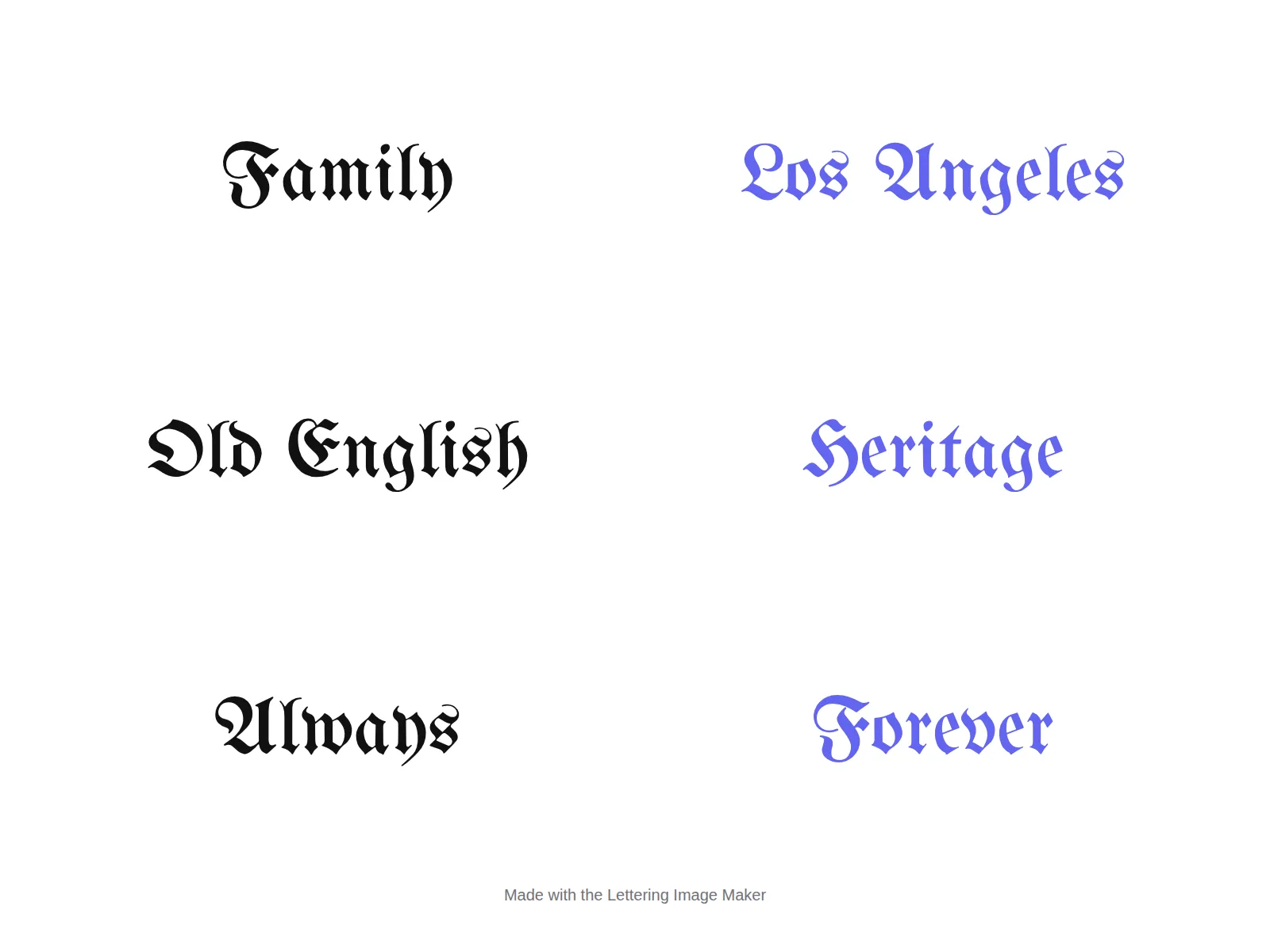
Unicode Fraktur is text, so it’s at the mercy of each device’s fonts and can’t be resized into a crisp graphic. For a tattoo stencil, a logo, a sticker, a cake topper or a printed certificate, use the Lettering Image Maker and choose the Old English style. It renders your words in a real blackletter typeface, with matching numbers, and downloads a PNG at the size you need.
If you want to see a single letter in every style first, the letters in different fonts pages show each Fraktur and bold Fraktur capital and lowercase next to the other alphabets. To draw blackletter by hand, the Old English letters pages go letter by letter. For a softer, rounder alternative for names, the cursive text generator is the usual second choice.
In short, use the Old English text generator for names and short lines, and the image maker when a design has to look identical everywhere.
Frequently asked questions
Basics
What is the Old English font called?
How do I type Old English letters on my phone?
What is the difference between Bold Gothic and regular Gothic?
Is Gothic text the same as the Gothic language?
Where it works
Can I use Old English letters for a tattoo?
Do Gothic letters work in Instagram and Discord names?
Will an Old English name work in a game?
How it works
Why do C, H, I, R and Z look different in Gothic text?
Are there Old English numbers?
Why does my Old English text look different on another device?
How many characters does Old English text use on X?
Tips & limits
Why does all-capitals Old English look so hard to read?
Can screen readers read Gothic text?
Related generators & guides
- Lettering Image MakerThis lettering generator draws your words in 16 display fonts, from bubble and graffiti to Old English and neon. Pick colours and effects, then download a sharp PNG.
- What Is Lettering? How It Differs From Calligraphy and TypographyWhat is lettering? It is drawing letters for one specific piece, unlike calligraphy, which writes letters in strokes, and typography, which arranges ready-made type. Here is what each term means, the tools, the history, and how to start drawing letters.
- Cursive Text GeneratorThis cursive text generator turns your words into script-style Unicode letters for names, bios and captions. Type your text, tap Copy and paste it into Instagram, TikTok, Discord or a message.
- Stylish Name GeneratorThis stylish name generator is also a name style generator: it turns your name into fancy Unicode letters with a frame such as ꧁ ꧂ and shows the real character count. Pick a style, tap Copy and paste it into a profile, a game or Discord.
- Fancy Letters A to ZEvery letter of the alphabet in every Unicode style, with code points.
- Bold Text GeneratorThis bold text generator turns your words into 𝗯𝗼𝗹𝗱 Unicode letters for posts, captions and bios that have no bold button. Type your text, tap Copy and paste it into LinkedIn, X, Instagram or Facebook.